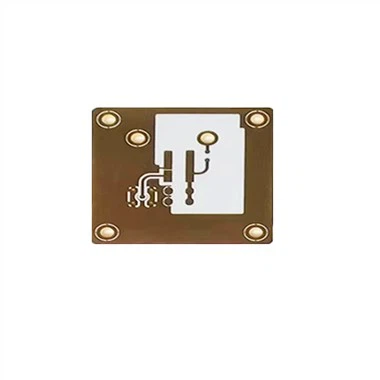
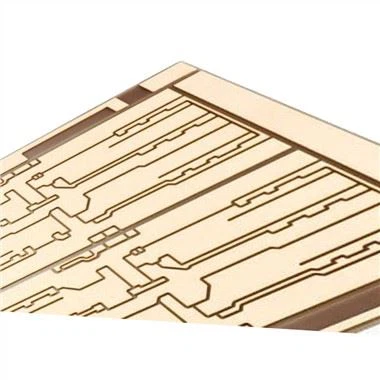
8OZ DPC Ceramic Circuit Board
8OZ DPC ceramic board substrate material is ALUMINA (>96%) and adopt the DPC manufacturing process. All vias is copper filled. Also, customer required the +/- 0.05 tolerance.And this copper thickness is 280um(8OZ).
Description
Product Decription
| Product Name: 8OZ DPC ceramic board | Layer counts: 2 Layer |
| Board Material: ALUMINA (>96%) | Copper Thickness: 8OZ(280um) |
| Board Thickness:0.9mm(900um) | Solder Mask: No(bottom and top) |
| Silkscreen : No(bottom and top) | Surface Finishing: ENIG+OSP |
| Metallization(Both sides):Direct plated copper(DPC) | Via: Copper filled |
8OZ DPC ceramic board Stackup

This is 8OZ DPC ceramic board stackup. Total thickness is 0.9mm, and the Top layer and bottom layer copper thickness is 280um. The board surface is ENIG. DPC ceramic circuit board refers to a direct copper-plated ceramic circuit board. It is a new type of ceramic circuit board. Compared with the traditional PCB (printed circuit board), it has higher reliability, better high-frequency performance and more Low thermal expansion coefficient and other advantages.
8OZ DPC ceramic board Advantages
DPC ceramic substrate features: high thermal conductivity, high insulation, high circuit resolution, high surface flatness, and high gold-ceramic bonding strength.

- DPC ceramic substrate also has many advantages
- Low communication loss - the dielectric constant of the ceramic material itself makes the signal loss smaller.
- High thermal conductivity - the thermal conductivity of alumina ceramics is 15~35w/mk, and the thermal conductivity of aluminum nitride ceramics is 170~230w/mk.
- More matching thermal expansion coefficient - the material of the chip is generally Si (silicon) GaAS (gallium arsenide). The thermal expansion coefficients of ceramics and chips are close. When the temperature difference changes drastically, there will not be too much deformation, causing wire desoldering and internal stress. And other issues.
- High bonding strength - The four-way ceramic circuit board product has a high bonding strength between the metal layer and the ceramic substrate, up to 45MPa (the strength of a ceramic sheet with a thickness of more than 1mm).
- Pure copper through-hole-stone ceramic DPC process supports PTH/Vias.
- High operating temperature - Ceramics can withstand fluctuating high and low temperature cycles, and can even work normally at temperatures as high as 600 degrees.
- High electrical insulation - Ceramic materials themselves are insulating materials and can withstand high breakdown voltages.
- Customized services - Beton can provide customized services according to customer needs, and conduct mass production according to the product design drawings (Gerber file and Parameter file) and requirements given by the user. Users have more choices and are more user-friendly.
DPC Process in Ceramic PCB Manufacturing
First, a laser is used to prepare through holes on the ceramic substrate (the aperture is generally 60μm~120μm), and then ultrasonic waves are used to clean the ceramic substrate; magnetron sputtering technology is used to deposit a metal seed layer (Ti/Cu target) on the surface of the ceramic substrate. Then, the circuit layer production is completed through photolithography and development; electroplating is used to fill the voids and thicken the metal circuit layer, and surface treatment is used to improve the solderability and oxidation resistance of the substrate. Finally, the dry film is removed and the seed layer is etched to complete the substrate preparation.
The diagram below briefly describes the DPC process in ceramic PCB manufacturing. The high-frequency dielectric constant and loss factor are then extracted using the simple electrical properties of the DPC substrate.

DPC Ceramic Circuit boards FAQ
(1)What is DPC ceramic board?
Thin film copper circuit boards made of ceramic substrates are DPC ceramic circuit boards. Another name for it is Ceramic DPC, this special type of thin film copper circuit board is most efficient at dissipating heat in high temperature areas.
(2)What are the commonly used materials for DPC ceramic circuit boards?
Alumina DPC ceramic plates are made of alumina and have a thermal conductivity range of 18 ~ 36 w/mk.
(3)What are the benefits of using DPC ceramic circuit boards?
a. High thermal expansion effect
b. Versatility
c. Good heat dissipation performance
Hot Tags: 8oz dpc ceramic circuit board, China, suppliers, manufacturers, factory, customized, buy, cheap, quotation, low price, free sample