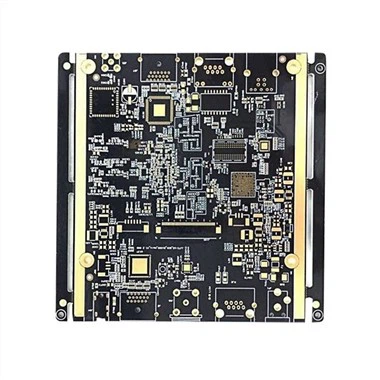
What is the production process of half-hole PCB board
Jun 17, 2022
Metal half hole (slot) means that one drill hole is holed and then the second drill and shape process are performed, and finally half of the metallized hole (slot) is retained, that is, the metallized hole on the edge of the plate is cut in half. It is also called stamp hole in the PCB industry. It is possible to directly weld the hole edge to the main edge to save connectors and space. It often appears in signal circuits. So, what is the production process of half-hole PCB board?

The production process of half-hole PCB board includes the following steps:
1. Outer circuit design;
2. The substrate pattern is electroplated with copper;
3. The substrate pattern is electroplated with tin;
4. Half hole treatment;
5. Removal of film;
6. Etching.
Process interpretation:
(1) How to control the product quality after forming the semi-metallized hole on the edge of the board, such as the copper thorn on the hole wall, the residue, etc., has always been a difficult problem in the processing process.
(2) For this type of PCB with a whole row of semi-metallized holes on the side of the board, it is characterized by a relatively small hole diameter, which is mostly used for the daughter board of the motherboard, and is welded with the motherboard and the pins of the components through these holes. If there are copper thorns left in these semi-metallized holes, when the manufacturer is soldering, it will lead to weak solder feet, virtual soldering, and serious bridge short circuit between the two pins.
The above is the production process of half-hole PCB board.