
AI Servers & Data Centers: Technical Requirements for Next-Gen PCB Materials
Mar 28, 2026
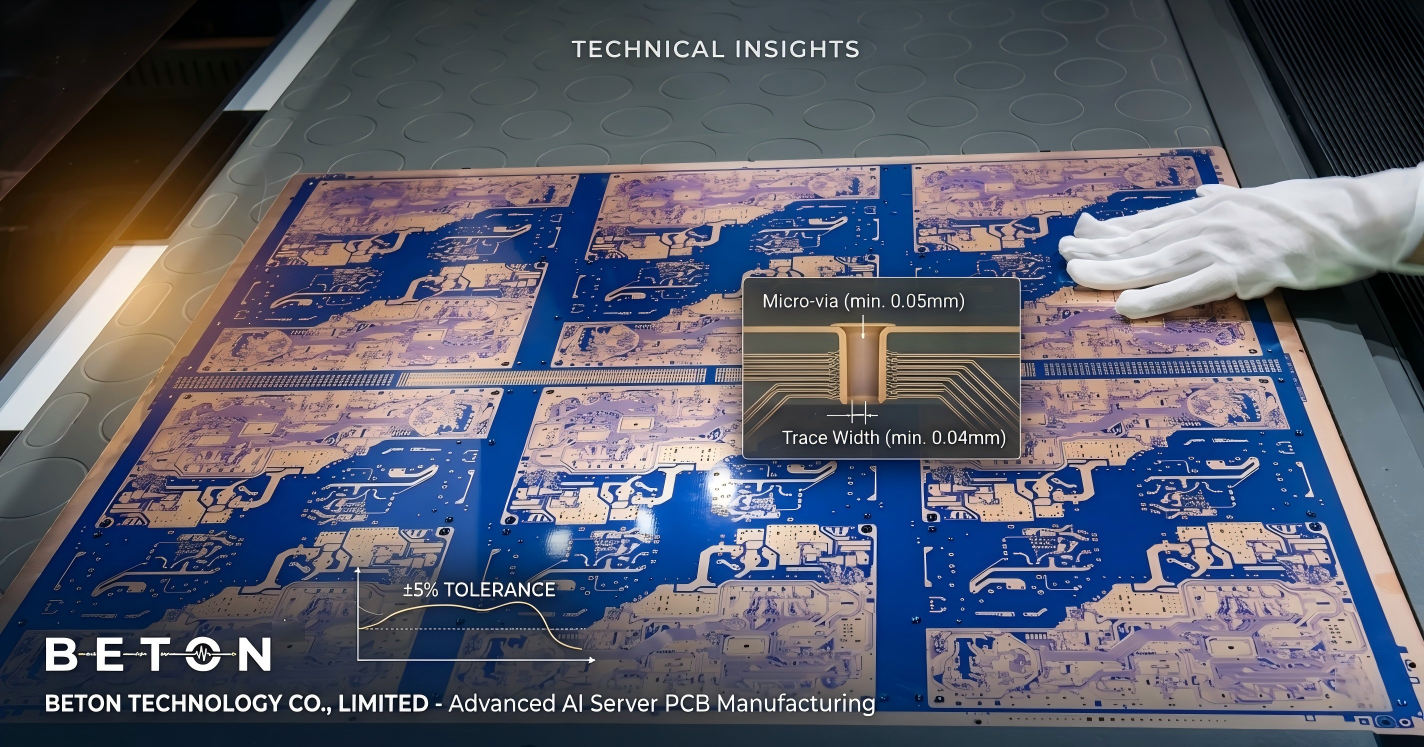
As AI LLMs (Large Language Models) like GPT-5 and Claude 4 continue to evolve, compute cores are transitioning from traditional CPUs to massive GPU clusters. As the foundational hardware, AI server PCBs face unprecedented challenges: layer counts exceeding 24+, and trace width/spacing shrinking below 40μm. Standard FR-4 materials can no longer support the stringent impedance requirements of PCIe 6.0 and NVLink protocols.
I. The Four "Hardcore" Indicators for AI Server PCBs
Ultra-Low Loss & Signal Integrity (SI): With transmission rates reaching 32Gbps and beyond, signal attenuation becomes a major bottleneck. Insulating materials must maintain a Dielectric Constant (Dk) fluctuation of ≤±0.05 and a Dissipation Factor (Df) of ≤0.0025 to ensure distortion-free transmission.
Precision Impedance Control (±5%): When trace widths are as narrow as 40μm, even microscopic variations in substrate thickness can cause impedance mismatches. Beton utilizes substrates with superior Dk uniformity and maintains a thickness tolerance of ≤±3% to guarantee signal consistency.
Extreme Thermal Management: AI chips can consume 500W to 1000W of power. We recommend utilizing next-gen insulating materials with a thermal conductivity of ≥1.2 W/(m·K) to effectively mitigate local hotspots and ensure long-term reliability.
Dimensional Stability for High-Layer Counts: The lamination process for 20+ layers is prone to internal stress, leading to registration errors. Materials must offer high peel strength (≥1.2 N/mm) and a low Coefficient of Thermal Expansion (CTE) to keep interlayer registration within ±3mil.
II. Core Material Applications: Beton's Manufacturing Practice
1. PTFE Ceramic-Filled Materials: The Choice for High-Precision Backplanes
For AI server solutions similar to the NVIDIA Rubin architecture, we frequently utilize Rogers RO4835 or equivalent high-precision laminates.
The Advantage: Df as low as 0.0018, paired with HVLP5 (Hyper Very Low Profile) copper foil.
Beton's Performance: We successfully achieve ±5% impedance tolerance on 24-layer backplanes, meeting millimeter-wave transmission standards.
2. Quartz Fiber Reinforced Resins: Critical for GPU Interconnects
For customized AI clusters for cloud giants like Google and ByteDance, quartz fiber materials are essential due to their near-zero CTE (0.54 ppm/℃).
Performance Boost: Combined with PCH resins, this can reduce high-speed signal insertion loss by more than 30%.
3. High-Thermal Conductivity Embedded Resistors
To optimize space and heat dissipation on high-density PCBs, Beton has introduced Embedded Resistor Technology.
Results: In a recent GPU baseboard project for a leading AI firm, this solution increased cooling efficiency by 40% while reducing the board area by 20%.
III. How Beton Ensures Successful AI Project Delivery
Hybrid Stack-up Design: We offer a balanced "Best-of-Both-Worlds" approach: PTFE ceramic materials for critical signal layers and high-performance hydrocarbon resins for internal layers to optimize cost and performance.
Strict Process Control: We utilize step-by-step lamination (heating rate ≤2℃/min) and diamond-coated drill bits to ensure hole wall roughness is kept under 0.8μm.
Global Compliance: All materials are UL 94 V-0 flame retardant and RoHS certified. Every shipment includes a comprehensive TDR Impedance Test Report.
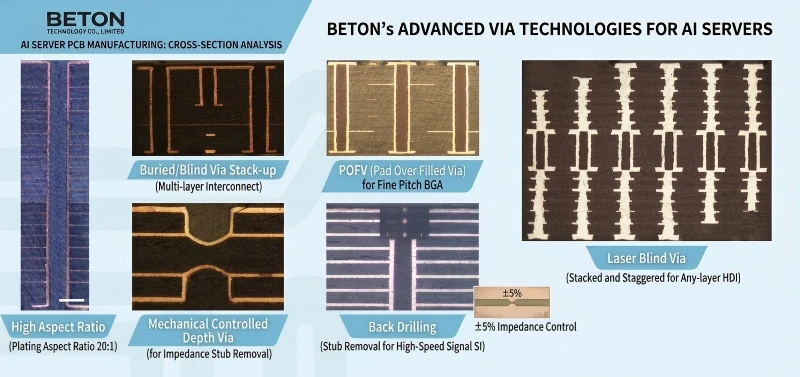
In the race for AI supremacy, the efficiency of compute power depends heavily on PCB material science. Beton is dedicated to overcoming the challenges of 40μm fine lines and high-frequency loss, providing a reliable hardware foundation for global innovators.
[Contact Beton's Engineering Team for a Free DFM Review of your AI Project]