
Al2O3, AIN, SiC...Comparison of performance and application fields of different ceramic materials
Jul 26, 2025
Alumina, aluminum nitride, silicon carbide... Performance comparison and applicable fields of different ceramic materials
At present, common ceramic substrate materials mainly include aluminum oxide (Al2O3), aluminum nitride (AlN), silicon carbide (SiC), beryllium oxide (BeO) and silicon nitride (Si3N4).
The performance comparison of different ceramic materials is as follows:
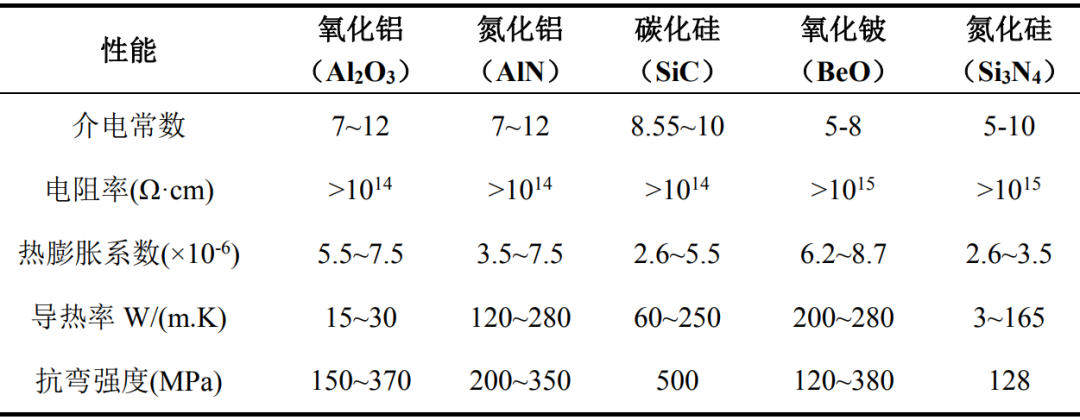
Al2O3 ceramics have the advantages of high output, low cost and good performance, and are widely used in various electronic products; currently, it is regarded as the most cost-effective ceramic material; but its comprehensive performance is not as good as aluminum nitride and beryllium oxide materials. In the context of the development of miniaturization, high frequency and high power of electronic products, aluminum oxide ceramics will eventually be replaced.
The thermal conductivity of AlN material is 4 to 7 times that of aluminum oxide material. It has the advantages of high mechanical strength and good corrosion resistance, so it is considered to be the most promising high thermal conductivity ceramic material. However, the material is currently difficult to prepare and cannot be mass-produced, which limits its application in the packaging field. After solving the manufacturing bottleneck, it will quickly occupy the market.
The single crystal silicon carbide of SiC ceramic has high thermal conductivity at room temperature, but the thermal conductivity of
SiC polycrystalline is very low. In addition, the dielectric constant of SiC ceramic is 4 times that of AlN ceramic, and it cannot be used in high-frequency environments. In short, the performance of SiC is average. Existing researchers have found that doping it can greatly improve the performance of the substrate, and further research is needed.
BeO ceramics have good thermal conductivity, mechanical strength and dielectric constant, and good comprehensive performance. However, the temperature of the BeO production process is as high as 1900℃, the cost is high, and the preparation process will produce toxic Be(OH)2 gas, which is extremely harmful to the human body. These shortcomings limit its application in electronic packaging. At present, it is mainly used in military nuclear energy and other fields.
Si3N4 has good wear resistance, high bending strength, and small thermal expansion coefficient. It is a ceramic material with the best comprehensive mechanical properties, but its preparation cost is high, the process is complicated, and the heat dissipation is insufficient. It is often used in occasions with high strength requirements but low heat dissipation requirements.