Introduction to knowledge points of EMI electromagnetic shielding
Nov 03, 2022
As an electronic engineer, noise and radiation are everywhere, and as an electronic designer, it is necessary to have knowledge about EMI electromagnetic shielding, and these knowledge and solutions will be widely used to improve equipment from external electromagnetic interference.
Maxwell's equations show that whenever current flows through a conductor, a magnetic field is created, and that magnetic field creates an electric field. The radiative properties of electric and magnetic fields are called radiative emissions. These radiated emissions will cause problems in the circuit or the entire printed circuit board (PCB). In an ideal circuit, the signal emitted by the circuit itself only includes current and voltage, but in the real world, noise is an inescapable problem. This happens when there is any disturbance to the circuit signal. Due to the nature of electromagnetic signals, the presence of noise cannot be avoided, but its effects can be greatly reduced. It should be noted that a device will not be affected by other devices during operation, just as a device will not be affected by other devices, electromagnetic susceptibility is the ability of a circuit system to remain functional when disturbed. This sensitivity will depend on the applied noise level, and different applications, such as automotive, medical, military, etc., have different degrees of magnetic susceptibility. Every circuit, device, or system must be properly designed to minimize radiation levels so that it is only sensitive to high levels of electromagnetic fields.
EMC certification
Electromagnetic Compatibility (EMC) certification is a mandatory step for any product to go to market, and every product must pass an EMC test to ensure that it is installed without affecting any other equipment (e.g. radiation testing) and even if other systems are present around (e.g., sensitivity test).
Typically, electronics are housed in enclosures, and metal enclosures are great at limiting electromagnetic shielding, but relatively imperfect. Holes or slots appear at the junction between the PCB and the housing, and electromagnetic fields can pass through them. In short, EMI shielding is to cover these holes or slots. In addition, there is a common problem in many product designs: EMC certification is only considered at the latest stage of the design cycle, in which case the overall design is frozen at this stage, and EMC engineers have no room to modify the product design. Solve electromagnetic related problems. Therefore, a complete set of tools and ecology, without the need to modify the PCB again, plays a crucial role in EMI shielding. Miniaturization and high performance have always been a global trend in the development of electronic products, and PCBs have shorter and shorter rise times and faster and faster digital circuits. The shorter the rise time, the larger the bandwidth, and at the same time the smaller the wavelength. Certain problems arise when the wavelengths in the circuit are comparable to the physical dimensions of the PCB. If these wavelengths are small enough, they may reach the outside and cause interference with other equipment. These openings can be closed with EMI shielding (that is, with magnetic materials that help cover these small holes and improve the Faraday cage effect of the mechanical enclosure).
Calculate EMI shielding effectiveness and skin depth
Countless EMI shields come in different materials and shapes, but in general the ultimate goal is to confine electromagnetic fields. The shielding element acts as a barrier against electromagnetic radiation, in fact, the process of this shielding method has a huge attenuation, which will depend on the electromagnetic wave and the material of the shielding element. When waves hit the shielding material, two new waves are generated, reflected and transmitted. Therefore, the energy of the incident wave will be split into these two waves. The transmitted component is the key relevant component, and the wave will pass through the shielding material to the outside. The effectiveness of the shield will determine its ability to attenuate this component. The skin depth is the distance a wave can travel before its amplitude decreases to 1/e, a parameter that depends on factors of material permeability, frequency and resistivity, and can be approximated by the following expression:
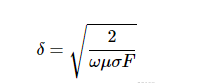
Note: σ represents conductivity, μ represents permeability, F represents frequency
The purpose of using shielding material is to minimize the amplitude of the wave after it has passed. Therefore, it is extremely important to choose the proper material type and its thickness t to ensure that all frequencies of the system are attenuated. How well the shielding material performs on this task depends on the shielding effectiveness (S.E) as follows:

Note: The first term represents reflection loss, and the second term represents absorption loss.
Types of EMI shielding The type of EMI shielding will largely depend on the type of product, electromagnetic requirements and environmental conditions. The most common EMI shields are as follows: - EMI gaskets - EMI shielding tapes - metal clips - shielded cabinets EMI gaskets EMI gaskets are used to cover irregular but existing micro-holes between two mechanical surfaces. Improve ground connection. They have sticky sections and many profiles so they can easily fit into different types of mechanical joints.
EMI Shielding Tape EMC tape is the first choice when you want to make sure all microvias are covered, but don't have much vertical space for options like EMI gaskets. These tapes have a highly conductive material (such as nickel or copper) on the top and adhesive on the other side.
Metal clips Any device needs a short, wide, and straight-through ground wire, and if this connection is not done well, unwanted monopoles will form, which will generate radiated electromagnetic fields. Metal clips improve this connection and strengthen the mechanical connection. Shielded Cabinets For interference sources such as CPUs, storage ICs, and radio frequency (RF) levels, it is an excellent choice to use shielding cabinets for individual shielding on the PCB layer.
Conclusion All circuits emit electromagnetic radiation and are easily radiated by other circuits. Obtaining the certifications needed to bring your product to market can be a painful testing process. Various forms and types of EMI shielding are fundamental to solving EMI problems.