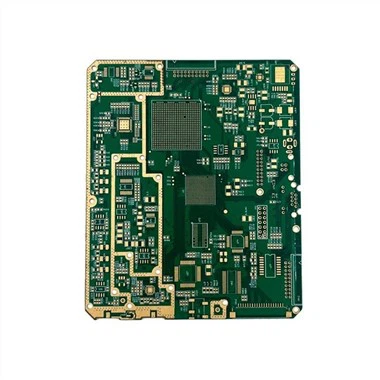
How to panel pcb, what are the ways of pcb paneling
May 21, 2022
PCB panel refers to the production of smaller PCB panels by circuit board manufacturers in order to facilitate production and save costs. In addition to improving production efficiency and saving costs, Panel can also facilitate Aseembly soldering in PCBA processing plants.
When making panels, you can easily separate multiple boards to avoid damaging the circuit boards during separation. Determine which panel method to use according to the shape of the single variety you are imposing. There are three main methods of PCB panel: V-CUT, punching, and stamp hole.
1. V-CUT
V-CUT means that several boards or the same board can be combined and spliced together, and then after the PCB is processed, a V-shaped groove is cut between the boards with a V-CUT machine, which can be broken apart during use. It's the more popular way nowadays.
2. Flushing
Punching refers to hollowing out between the board and the board or inside the board with a milling machine as needed, which is equivalent to digging out.
3. Stamp hole
The use of stamps mentioned here is to use small holes to link the plates to the plates, which looks like the zigzag on the stamps, so it is called a stamp hole link. The stamp hole link is that high control burr is required on all sides between the board and the board, that is, only a little stamp hole can be used in place of the V line.
PCB panel tips
1. The outer frame (clamping edge) of the PCB panel should adopt a closed-loop design to ensure that the PCB panel will not be deformed after being fixed on the fixture.
2. The width of the PCB panel is ≤260mm (SIEMENS line) or ≤300mm (FUJI line); if automatic dispensing is required, the width of the PCB panel × length ≤ 125mm × 180mm.
3. The outer line of the PCB panel should be as close to a square as possible. It is recommended to use 2×2, 3×3,...
4. The center distance between the small plates is controlled between 75mm and 145mm.
5. When setting the reference positioning point, generally leave a non-resistance area 1.5mm larger than the positioning point around the positioning point.
6. There should be no large devices or protruding devices near the connection point between the outer frame of the Panel and the inner small board, and between the small board and the small board, and there should be a space greater than 0.5mm between the edge of the components and the PCB board to avoid Ensure the normal operation of the cutting tool;
7. Four positioning holes are opened at the four corners of the outer frame of the jigsaw, with a diameter of 4mm±0.01mm; the strength of the holes should be moderate to ensure that it will not break during the process of upper and lower plates; the hole diameter and position accuracy should be high, and the hole wall should be smooth and free of burrs .
8. Each small board in the PCB panel must have at least three positioning holes, 3≤diameter≤6mm, and no wiring or assembly is allowed within 1mm of the edge positioning hole.
9. For the positioning of the entire board of the PCB and the reference symbols for the positioning of fine-pitch devices, in principle, the QFP with a spacing of less than 0.65mm should be set at its diagonal position; the positioning reference symbols for the panelPCB sub-board should be used in pairs. Placed at the opposite corners of the positioned feature.