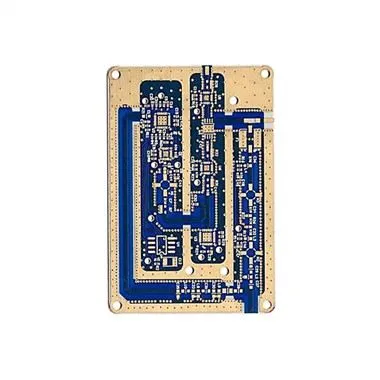
Why is gold plating on PCB boards
Jan 08, 2024
1. PCB board surface finishing:
Anti-oxidation, HASL, lead-free HASL, immersion gold, immersion tin, immersion silver, hard gold plating, full board gold plating, gold finger, nickel-palladium OSP: lower cost, good solderability, harsh storage conditions, short time, Environmentally friendly technology, good welding, and smooth.
HASL: HASL board is generally a multi-layer (4-46 layer) high-precision PCB template. It has been used by many large-scale domestic communication, computer, medical equipment and aerospace enterprises and research units. It has a golden finger (connecting finger). It is the connecting component between the memory stick and the memory slot. All signals are transmitted through the gold finger.
Gold fingers are composed of many golden conductive contacts. Because the surface is gold-plated and the conductive contacts are arranged like fingers, they are called "gold fingers".
Gold fingers are actually covered with a layer of gold on a copper-clad board through a special process, because gold is extremely resistant to oxidation and has strong conductivity.
However, due to the high price of gold, currently more memory is replaced by tin plating. Since the 1990s, tin materials have become popular. Currently, almost all "gold fingers" of motherboards, memory and graphics cards are used. Tin material, only some high-performance server/workstation accessory contact points will continue to use gold plating, which is naturally expensive.
2. Why use gold-plated plates?
As ICs become more integrated, IC pins become more dense. The vertical HASL process is difficult to blow the thin pads flat, which makes SMT mounting difficult; in addition, the shelf life of the spray tin plate is very short.
The gold-plated plate just solves these problems:
1. For the surface mount process, especially for 0603 and 0402 ultra-small surface mounts, the flatness of the solder pad is directly related to the quality of the solder paste printing process and has a decisive impact on the subsequent reflow soldering quality. Therefore, the entire board Gold plating is often seen in high-density and ultra-small surface mount processes.
2. In the trial production stage, due to factors such as component procurement, it is often not possible to solder the board as soon as it comes. Instead, we often have to wait several weeks or even months before using it. The shelf life of gold-plated boards is longer than that of lead. Pewter alloy is many times longer, so everyone is happy to use it.
Besides, the cost of gold-plated PCB in the prototyping stage is almost the same as that of lead-tin alloy plate.
But as the wiring becomes denser, the line width and spacing have reached 3-4MIL.
This brings about the problem of gold wire short circuit: as the frequency of the signal becomes higher and higher, the signal transmission in multiple coatings due to the skin effect has a more obvious impact on the signal quality.
The skin effect refers to: high-frequency alternating current, the current will tend to flow concentrated on the surface of the wire. According to calculations, skin depth is related to frequency.
In order to solve the above problems of gold-plated boards, PCBs using immersed gold boards mainly have the following characteristics:
1. Because the crystal structures formed by immersion gold and gold plating are different, immersion gold will be golden yellower than gold plating, and customers will be more satisfied.
2. Immersion gold is easier to weld than gold plating and will not cause poor welding or customer complaints.
3. Since the immersion gold board only has nickel gold on the pad, the signal transmission in the skin effect is in the copper layer and will not affect the signal.
4. Because the crystal structure of immersion gold is denser than gold plating, it is less likely to cause oxidation.
5. Since the immersion gold plate only has nickel gold on the pad, it will not produce gold wires and cause short spots.
6. Because the immersion gold board only has nickel gold on the pad, the solder resist on the circuit is more firmly bonded with the copper layer.
7. The project will not affect the spacing during compensation.
8. Because the crystal structures formed by immersion gold and gold plating are different, the stress of the immersion gold plate is easier to control. For products with bonding, it is more conducive to bonding processing. At the same time, it is precisely because immersed gold is softer than gold plating that gold fingers made of immersed gold plates are not wear-resistant.
9. The flatness and service life of the immersed gold plate are as good as those of the gold-plated plate.
For the gold plating process, the tin application effect is greatly reduced, while the tin application effect of immersion gold is better; unless the manufacturer requires binding, most manufacturers now will choose the common immersion gold process In this case, the PCB surface treatment is as follows:
Gold plating (electroplating, immersion gold), silver plating, OSP, HASL (lead and lead-free).
These types are mainly for boards such as FR-4 or CEM-3. The paper base material and the surface treatment method of coating with rosin; if the problem of poor tin application (poor tin eating) is excluded, solder paste and other patch manufacturers are excluded. Due to production and material technology reasons.
Here we only talk about PCB issues. There are several reasons:
1. When printing PCB, whether there is oil leakage film surface on the PAN position, which can block the effect of tin application; this can be verified by a tin drift test.
2. Whether the PAN position meets the design requirements, that is, whether the pad design can adequately ensure the support of the parts.
3. Whether the pad is contaminated or not, the results can be obtained by using ion contamination test; the above three points are basically the key aspects to be considered by PCB manufacturers.
Regarding the advantages and disadvantages of several methods of surface treatment, each has its own strengths and weaknesses!
In terms of gold plating, it allows the PCB to be stored for a longer time, and is less affected by the external environmental temperature and humidity (compared to other surface treatments), and can generally be stored for about a year; spray tin surface treatment is second, and OSP is third. A lot of attention should be paid to the storage time of the two surface treatments in the ambient temperature and humidity.
Generally speaking, the surface treatment of immersed silver is a little different, the price is higher, the storage conditions are more stringent, and it needs to be packaged in sulfur-free paper! And the storage time is about three months! In terms of tin application effects, immersion gold, OSP, HASL, etc. are actually almost the same. Manufacturers mainly consider cost-effectiveness!