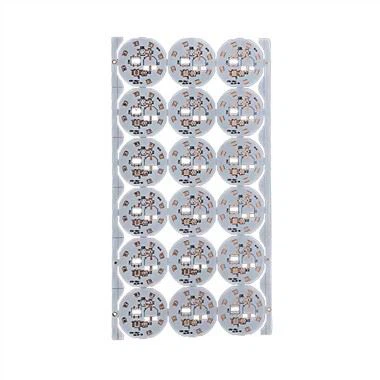
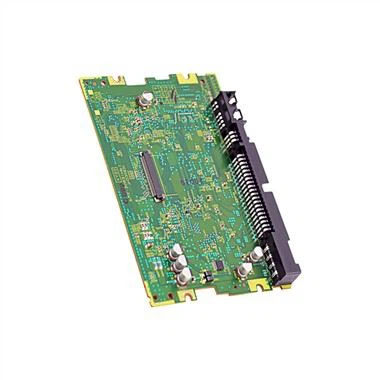
Aluminum substrate product features
Feb 15, 2022
Aluminum substrate (metal-based heat sink (including aluminum substrate, copper substrate, iron substrate)) is a low-alloyed Al-Mg-Si series high-plastic alloy plate (see the figure below for the structure), which has good thermal conductivity, electrical insulation Compared with the traditional FR-4, the aluminum substrate adopts the same thickness and the same line width, the aluminum substrate can carry higher current, the withstand voltage of the aluminum substrate can reach 4500V, and the thermal conductivity is greater than 2.0. The industry is dominated by aluminum substrates.
●Using surface mount technology (SMT);
Street light aluminum substrate
Street light aluminum substrate
●Effectively deal with heat diffusion in circuit design scheme;
●Reduce the operating temperature of the product, improve the power density and reliability of the product, and prolong the service life of the product;
● Reduce product volume, reduce hardware and assembly costs;
●Replace fragile ceramic substrate for better mechanical durability. structure
Aluminum-based copper clad laminate is a metal circuit board material, which consists of copper foil, thermal insulation layer and metal substrate. Its structure is divided into three layers:
Cireuitl.Layer circuit layer: equivalent to the copper clad laminate of ordinary PCB, the thickness of the circuit copper foil is loz to 10oz.
DielcctricLayer insulating layer: The insulating layer is a layer of thermally conductive insulating material with low thermal resistance. Thickness: 0.003" to 0.006" inch is the core technology of aluminum-based copper clad laminate, which has obtained UL certification.
BaseLayer: It is a metal substrate, usually aluminum or optional copper. Aluminum base copper clad laminate and traditional epoxy glass cloth laminate, etc.
Compared with other materials, PCB materials have incomparable advantages. Suitable for surface mount SMT public arts of power components. No radiator is needed, the volume is greatly reduced, the heat dissipation effect is excellent, and the insulation performance and mechanical performance are good.
Aluminum substrate for fluorescent lamps
Aluminum substrate for fluorescent lamps
The LED die substrate is mainly used as a medium for the heat transfer between the LED die and the system circuit board, and is combined with the LED die by the process of wire bonding, eutectic or flip chip. Based on heat dissipation considerations, the LED die substrates on the market are mainly ceramic substrates, which can be roughly divided into three types: thick-film ceramic substrates, low-temperature co-fired multilayer ceramics, and thin-film ceramic substrates based on different circuit preparation methods. For high-power LED components, thick-film or low-temperature co-fired ceramic substrates are often used as the die heat dissipation substrate, and then the LED die and the ceramic substrate are combined with gold wires. As mentioned in the introduction, this gold wire connection limits the efficiency of heat dissipation along the electrode contacts. Therefore, domestic and foreign manufacturers are all working hard to solve this problem. There are two solutions. One is to find a substrate material with high heat dissipation coefficient to replace aluminum oxide, including silicon substrate, silicon carbide substrate, anodized aluminum substrate or aluminum nitride substrate. Among them, silicon and silicon carbide substrates are semiconductor materials. However, the anodized aluminum substrate is prone to breakage due to the insufficient strength of the anodized oxide layer, which limits its practical application. The more mature and generally accepted one is the use of aluminum nitride as the heat dissipation substrate; however, the traditional thick film process is not suitable for the aluminum nitride substrate (the material must be heat treated at 850 ℃ after the silver paste is printed to make it material reliability problem), therefore, the aluminum nitride substrate circuit needs to be prepared by a thin film process. The aluminum nitride substrate prepared by the thin film process greatly accelerates the efficiency of heat from the LED die to the system circuit board through the substrate material, thus greatly reducing the burden of heat from the LED die to the system circuit board through the metal wire, thereby achieving high heat dissipation Effect