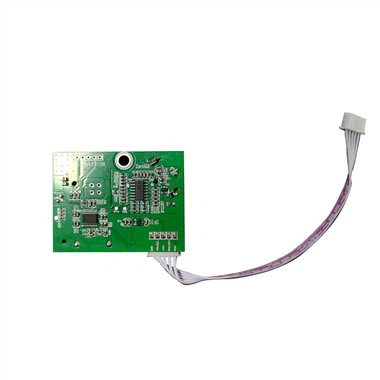
How To Solder Flex Pcb
May 12, 2022
Flexible circuit board operation steps
1. Before soldering, apply flux on the pad and treat it with a soldering iron to avoid poor tin plating or oxidation of the pad, resulting in poor soldering, and the chip generally does not need to be processed.
2. Use tweezers to carefully place the PQFP chip on the PCB, taking care not to damage the pins. Align it with the pads, making sure the chip is placed in the correct orientation. Adjust the temperature of the soldering iron to more than 300 degrees Celsius, dip a small amount of solder on the tip of the soldering iron, press down on the chip that has been aligned with the tool, and add a small amount of flux to the pins at the two opposite corners. Hold the chip down and solder the pins on two opposite corners so that the chip is fixed and cannot be moved. Recheck the alignment of the chip after soldering the diagonal corners. Adjust if necessary or remove and realign on PCB.
3. To start soldering all pins, add solder to the tip of the soldering iron and apply flux to all pins to keep the pins wet. Touch the end of each pin of the chip with the tip of the soldering iron until you see solder flowing into the pin. When soldering, keep the tip of the soldering iron parallel to the pins to be soldered to prevent overlapping due to excess solder.
4. After soldering all leads, wet all leads with flux to clean the solder. Absorb excess solder where needed to eliminate any shorts and laps. Finally, use tweezers to check whether there is any virtual soldering. After the inspection is completed, remove the flux from the circuit board, dip a stiff brush in alcohol and wipe it carefully along the direction of the pins until the flux disappears.
5. SMD RC components are relatively easy to solder. You can put tin on a solder joint first, then put one end of the component, clamp the component with tweezers, and solder one end, and then check whether it is placed correctly; If it is straight, then solder the other end.
Flexible circuit board soldering precautions
In terms of layout, when the size of the circuit board is too large, although the soldering is easier to control, the printed lines are long, the impedance increases, the anti-noise ability decreases, and the cost increases; if it is too small, the heat dissipation decreases, the soldering is difficult to control, and adjacent lines are prone to appear. Mutual interference, such as electromagnetic interference of circuit boards, etc. Therefore, the PCB board design must be optimized:
(1) Shorten the connection between high-frequency components and reduce EMI interference.
(2) Components with heavy weight (such as more than 20g) should be fixed with brackets and then welded.
(3) The heat dissipation problem should be considered for the heating element to prevent defects and rework caused by large ΔT on the surface of the element, and the thermal element should be kept away from the heat source.
(4) The arrangement of components should be as parallel as possible, which is not only beautiful but also easy to weld, and should be mass-produced. The board design is a 4:3 rectangle (best). Do not change the wire width abruptly to avoid wiring discontinuities. When the circuit board is heated for a long time, the copper foil is easy to expand and fall off. Therefore, the use of large-area copper foil should be avoided. The above is the welding of the flexible circuit board, I hope it can help you.