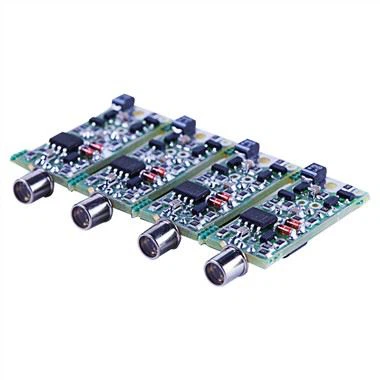
China's Ceramic Circuit Board Industry Tends To Mature, And The Market Has Broad Prospects For Development
May 18, 2022
Ceramic-based circuit boards are electronic components that use ceramics as the matrix material and make metal circuits on them. They are an indispensable key basic material for power module packaging in the electronic field. Ceramic-based circuit boards have the advantages of thermal conductivity, heat resistance and high reliability, and are currently the best choice for circuit substrates in applications such as high-power LEDs, power devices, microwave devices, automotive electronics, high-frequency devices, and solar cell modules.
The preparation methods of traditional ceramic substrates can be divided into four categories: HTCC, LTCC, DBC and DPC. The preparation method of HTCC (high temperature co-firing) requires a temperature above 1300 ° C, but due to the influence of electrode selection, the preparation cost is quite expensive. Poor, the thermal conductivity of the finished product is low. The preparation method of DBC requires the formation of an alloy between the copper foil and the ceramic, and the calcination temperature needs to be strictly controlled within the temperature range of 1065-1085°C. Because the preparation method of DBC has requirements on the thickness of the copper foil, it is generally not possible to Below 150~300 microns, thus limiting the wire aspect ratio of such ceramic circuit boards.
The preparation method of DPC includes vacuum coating, wet coating, exposure and development, etching and other process links, so the price of its products is relatively high. In addition, in terms of shape processing, the ceramic-based circuit board needs to be laser-cut, which cannot be accurately processed by traditional drilling, milling and punching machines, so the bonding force and line width and spacing are also finer.
From 2001 to 2002, affected by factors such as the slowdown of world economic growth, the growth rate of my country's printed circuit board industry has dropped significantly. In 2001 and 2002, the industry output value increased by less than 5% year-on-year. After 2003, with the recovery of the global economy and the emergence and wide application of emerging electronic products, the demand for printed circuit boards has grown rapidly again, and the output value of my country's printed circuit board industry has recovered to an annual growth rate of about 30%. In 2005, the output value of my country's printed circuit board industry increased by about 31.4% year-on-year.
In 2007, the pace of economic growth slowed down, and the recovery from the second half of 2003 to 2006 seems to have come to an end, but China's growth can still be achieved by the transfer of production capacity from developed countries.
The ceramic circuit board industry has been developing for many years and has already matured. At present, the overall market structure has long been clear. Domestic manufacturers such as Silitong, Aisibo, Hongxin, and Tongxin have taken the lead, and small and medium-sized manufacturers have also begun to pour in. hot. In the context of Made in China 2050, the PCB industry also has to keep up with the pace. In the era of data being king, ceramic circuit boards have to be constantly updated and upgraded to keep up with the pace of the industrial revolution. It is hoped that the ceramic circuit board manufacturers headed by Slitton can continue to make progress and stand at the forefront in the wave of the industrial revolution.
Ceramic circuit boards are actually made of electronic ceramics and can be made of various shapes. Among them, the characteristics of high temperature resistance and high electrical insulation performance of ceramic circuit boards are the most prominent, and the advantages of low dielectric constant and dielectric loss, high thermal conductivity, good chemical stability, and similar thermal expansion coefficient to components are also very significant. The production of ceramic circuit boards will use LAM technology, that is, laser rapid activation metallization technology. Used in the field of LED, high-power power semiconductor modules, semiconductor refrigerators, electronic heaters, power control circuits, power hybrid circuits, intelligent power components, high-frequency switching power supplies, solid state relays, automotive electronics, communications, aerospace and military electronics components.
Compared with other PCBs, ceramic circuit boards can be regarded as a substitute for the old generation of substrates, which can perfectly replace metal substrates and transparent substrates. Because of its high thermal conductivity, high insulation, and better thermal expansion matching coefficient, it has become a favorite in the field of high-power lighting.
Ceramic circuit boards are different from traditional FR-4 (plastic), ceramic materials have good high-frequency performance and electrical properties, and have properties that organic substrates do not have, such as high thermal conductivity, excellent chemical stability and thermal stability. It is an ideal packaging material for a new generation of large-scale integrated circuits and power electronic modules. Therefore, ceramic circuit boards have received extensive attention and rapid development in recent years.
The future ceramic circuit boards need to come out of the embrace of LED and embrace the advent of the new industrial era. At present, the largest application of ceramic circuit boards is still in the field of LEDs. However, the market for PCBs is terrifying. On the eve of the advent of the intelligent era, ceramic circuit boards should be prepared to face them. The application field of artificial intelligence chips may become ceramic circuit boards. The new territory of the LED field will only be the swaddling clothes of ceramic circuit boards. In the context of Made in China 2050, the PCB industry also has to keep up with the pace. In the era of data being king, ceramic circuit boards have to be constantly updated and upgraded to keep up with the pace of the industrial revolution.
The ceramic-based circuit board industry research report focuses on analyzing the development status and characteristics of China's ceramic-based circuit board industry, as well as the challenges that China's ceramic-based circuit board industry will face, and the development strategies of enterprises. The report also made a detailed analysis of the development trend of the global ceramic-based circuit board industry, and made a trend study and judgment on the ceramic-based circuit board industry. How will the ceramic-based circuit board industry develop in the future? Please pay attention to the report "2020-2025 Ceramic-based Circuit Board Industry Market In-Depth Analysis and Development Strategy Research Report" by the Research Institute of China Research Institute.